Ask most agency owners why a producer quit after the busy season and you will hear the same three answers. The labor market is tight. People don't want to work anymore. Someone offered them a few more points on commission.
Each of those can be true, and each is mostly outside your control, which is what makes those explanations comfortable.
None of them is the whole story. Pay and culture both matter, and a producer who feels underpaid or unsupported has a real reason to look around. Alongside them sits a set of factors owners often miss: who you hire, how you train them, and whether your system lets a good producer succeed year round. The agency looks like a machine in peak season and an empty room in April, and a producer who cannot see how to win in April starts looking for a floor where they can.
What Producer Turnover Looks Like From the Floor
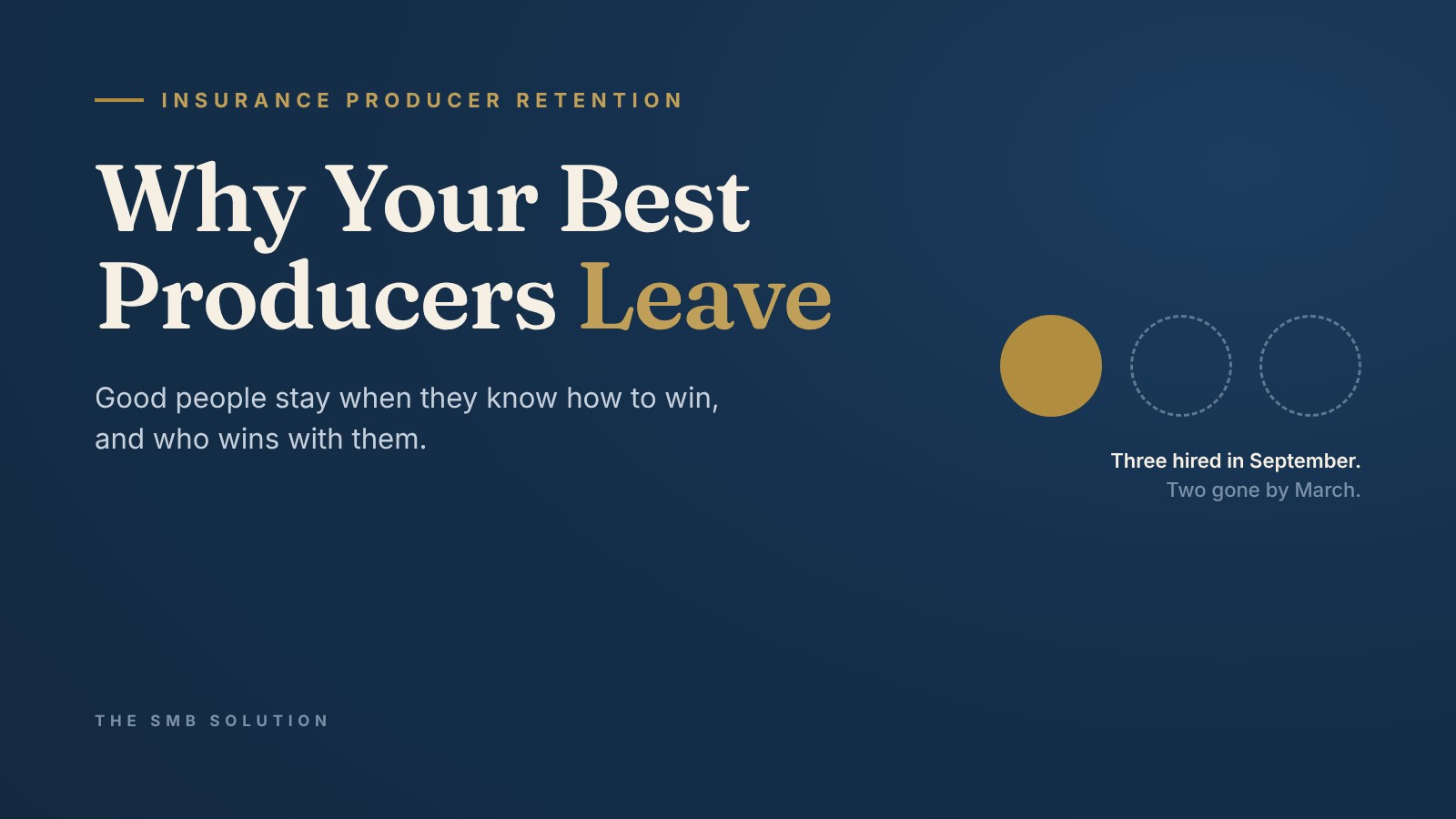
An agency owner hired three producers in September. By March, two were gone.
His explanation was the market. When we looked at the floor, a different pattern showed up. There was no leaderboard. There was no daily standard for what a producer should do before lunch. There was no product strategy for the months after the busy season ended.
A new hire in that room could not answer a basic question: am I winning today? Nobody had defined what winning looked like on an ordinary Tuesday, so nobody could tell them.
The environment offered no momentum. People with drive notice that quickly, and they do not wait around to be proven right.
What a Producer's Exit Is Telling You
When a good producer leaves, it is easy to take it personally, or to blame them. But if you listen closely, they are often giving you feedback.
A good producer who leaves has looked at the pay, the culture, and the way the days actually run, and decided they could not see a future there. That is not a betrayal. It is information about the business you built.
In a way, your producers are not quitting the job. They are reviewing the owner, and the review is worth reading.
Producer Retention Starts Before the First Day
Whether someone stays is shaped before they ever walk through the door. It starts with who you hire, and what you tell them the job is.
Most agencies recruit when they are desperate, which means they hire whoever is available and hope the system sorts it out. Like the agency that hired three in September, they staff up because the phones are about to get busy. The promise made in that interview is rushed, vague, or oversold, and the new hire carries it into day one.
Good recruiting is the opposite of desperation. You know what a strong producer looks like in your agency, you tell candidates honestly what the job is, and you hire for the long stretch, not the rush. A clear picture of the role also protects the people you bring in, because they can decide for themselves whether they want it.
Then comes the first day, and the promise gets tested. The producer who was told what winning looks like finds out whether it was true. If the first day matches the interview, trust starts building. If it doesn't, the clock on their exit has already started.
Why Producer Onboarding Decides Who Stays
A new hire spends their first ninety days deciding whether you told the truth. If training is a few shadowed calls and a pat on the back, they conclude the rest of the job will be improvised too.
Strong training does two things. It gets people productive fast, so they feel progress inside the first month. And it gives them skills they keep, which matters more than you might expect by the end of this post.
Why Peak Season Hides Your Retention Problem
Peak season is the best camouflage a weak system ever gets. Demand is high, the phones are busy, and almost everyone who works hard gets a result. The agency looks healthy.
Then the rush ends. Volume drops, the easy conversations disappear, and a producer has to create their own activity. This is where systems separate from seasons. If your agency has a way to generate and track work in the off months, producers keep winning. If it does not, they spend the slow months waiting for the next rush.
Owners then read the exits as a seasonal pattern and plan to rehire every year. That turns a fixable design problem into a calendar event nobody questions. Seasonal turnover is not a law of nature. In many agencies it is simply what happens when winning only works during the busy season.
Four Questions Your Producers Cannot Answer
Go back to that ordinary Tuesday. Picture a producer at 10 a.m. on a Tuesday in April. What can they see?
- Where they stand. Is there a number, visible to everyone, that shows who is ahead this week and by how much?
- What a good day is. Has anyone defined the dials, quotes, reviews, or appointments that make a day a win, or are they guessing?
- What they are selling. Is there a product to lead with when the busy season is over, or are they waiting for the phone to ring?
- Where this goes. Can they see the next step in their career and the path to it, or does every year look like the last one?
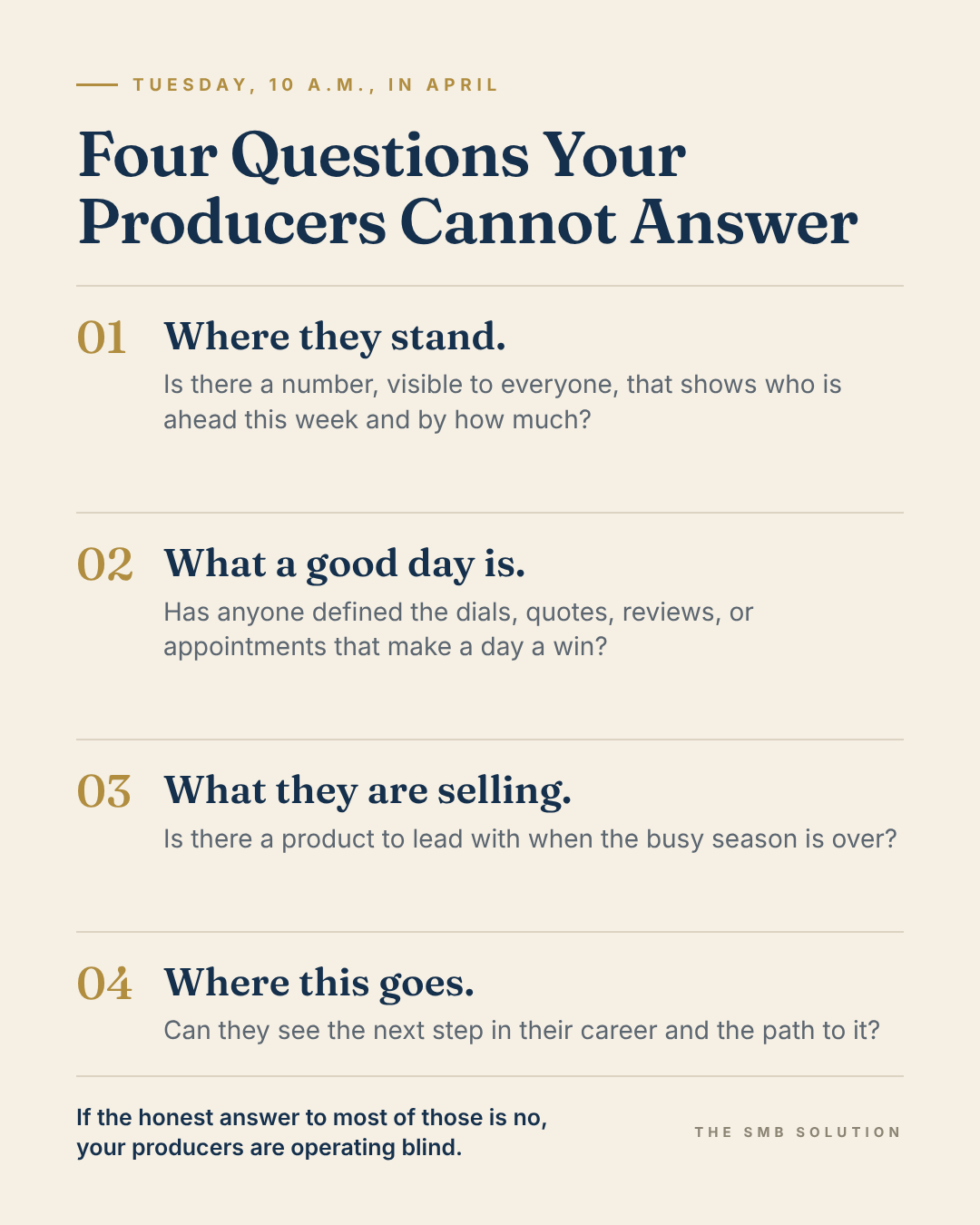
If the honest answer to most of those is no, your producers are not underperforming. They are operating blind, and the ones with options will use them.
How to Improve Insurance Producer Retention
Four things make performance obvious. They work alongside good pay and a strong culture, and none of them needs a big budget.
A scoreboard that updates daily. Pick two or three numbers that predict revenue, such as quotes delivered, appointments held, and policies written. Post them where everyone sees them. People compete with what they can see, so visibility does a lot of the managing for you.
A daily standard. Define what a producer does every day, in plain numbers. When the standard is clear, a new hire knows within a week whether they are on track, and so do you. Nobody guesses, and nobody is surprised in a review.
An off-season product plan. Decide what your producers lead with when the busy season ends, whether that is a cross-sell, a client review campaign, or another line of coverage. Give them the scripts, the lead flow, and a weekly target. The goal is simple: no month of the year without a way to win.
A visible path up. Show what a producer does and earns at each stage, and what it takes to move to the next one. People stay where they can see themselves getting better and getting paid more. A job with no visible next step is a job they are already planning to leave.
Each of these moves work off your desk and onto a system, which is the same shift that separates a business from a job.
Why Team Purpose Keeps Producers Longer Than Pay
Everything above is about one producer making one decision for themselves. But people also stay for something bigger than their own number.
The strongest agencies give their people a purpose. Not a slogan on the wall, but a clear answer to why the work matters: the families protected, the businesses kept running, the clients who call because they trust you. When a producer can see how their win helps a client and helps the team, the job stops being a quota and starts being a contribution.
That shows up in small habits. Set a team goal alongside the individual ones, so a good week belongs to everyone. Celebrate wins out loud, in front of the group. Let your stronger producers share what works, and recognize them for it. When one person wins, everyone should feel it, and when someone struggles, the team notices early enough to help.
People leave a scoreboard. They stay for a team.

Your 30-Day Producer Retention Checklist
You do not need to rebuild the agency to fix this. Start with the smallest version of each piece.
- Write a one page description of what a strong producer looks like in your agency, and use it to screen your next hire
- Choose two or three activity numbers that predict revenue and track them daily
- Put a simple leaderboard where every producer can see it, updated at the end of each day
- Write the daily standard on one page and walk each producer through it
- Map the first 30 days for a new hire, with one skill and one result due each week
- Pick one off-season product to lead with and give the team a script and a weekly target
- Check that your pay plan and team habits reward the same behaviors you are now measuring
- Sit down with each producer and map what the next level looks like and what it pays
- Ask your best producer what would make a Tuesday in April feel like a win, then act on the answer
Retention work compounds the same way keeping a client does. Every producer you keep is one you do not have to recruit, onboard, and ramp from zero.
Not Every Departure Is a Retention Failure
Good people stay, and still, some should leave. Here is the part owners resist: leaving is not always a failure. A producer who has outgrown the seat, found a better fit, or simply wants a different life is not a failure of your agency.
The goal is not that nobody ever leaves. The goal is that everyone who passes through your agency adds real value while they are here and walks out better than they arrived, a stronger producer and a stronger professional. Do that consistently and something compounds. Your recruiting gets easier because alumni speak well of you. Your training improves because you keep learning what works. Each new hire starts from a higher standard than the last, and you keep leveling up.
Pay and culture matter, and so does the environment you build around them. Stop treating seasonal turnover as inevitable. Make performance obvious and measurable every day, in every season, so a good producer always knows how to win.
You Don't Have to Build This Alone
If you read this and saw your own agency, you are not behind. You are an owner doing multiple jobs.
This is the work I do with agency owners. The people pillar is one of the seven areas I look at in every business, and it covers three things: how you recruit, how you train, and whether good people have a reason to stay. Together we define what a strong producer looks like, build the onboarding and training that gets new hires productive fast, put a scoreboard and a daily standard in place, and map the path from first day to next level.
If this post sounded like your agency, book a 45 minute diagnostic and we will look at your people pillar first.
Frequently Asked Questions
Why do insurance producers leave agencies?
Pay and culture matter, but owners often miss three structural causes: hiring under pressure without a clear picture of the role, onboarding that improvises after the first week, and a system that only produces wins during peak season. A producer who cannot see how to win in the off months starts looking elsewhere.
What is a good producer retention rate for an insurance agency?
Rather than chasing a benchmark, measure how long new producers last against your own ramp period. If producers routinely leave before they reach full production, the agency is paying full recruiting and training cost without ever collecting the return.
How long does it take a new producer to become productive?
Most agencies look at the first ninety days. Strong onboarding shows a new hire measurable progress inside the first month, with one skill and one result due each week, so they can tell whether they are on track before anyone has to tell them.
Does paying more commission fix producer turnover?
Not on its own. Commission is one reason producers stay, but a higher split does not help a producer who cannot see where they stand, what a good day looks like, or what to sell once peak season ends. Pay competitively, then fix what makes winning visible.
Why does producer turnover spike after the busy season?
Peak season hides a weak system. When volume is high, almost anyone working hard gets results. When the rush ends and producers have to create their own activity, agencies without an off-season plan give them no way to win, and the exits follow.